Dear John,
Kim Petrina, our district’s Director of Communications, indicated that you were looking to write an article on how the Ohio Department of Education rated our school district through their report card. You certainly can go on to ODE’s website or wade through cleveland.com to see those grades. I recognize that you’re “doing your job” and I hope that you can appreciate that I need to do mine. The conversation about this needs to change.
Our response is this…we reject their accountability system. We recognize that current Ohio Law requires the Department of Education to create these grades and that we’re required to administer the assessments to our children and provide the data that the ODE requires. Nevertheless, we reject the system because it runs counter to our locally created agenda. If you go to our Facebook page and scroll down you will see a recent Board Resolution that was passed. It serves as our response to any question asked about Ohio’s current accountability system and how we performed within it.
We believe that the student achievement metric is but one component within a system that should be meant to define a much larger and more important metric–Student Success. While the Ohio General Assembly is obsessed with test scores, the Olmsted Falls City School District is not and we have chosen to pursue another path. We are encouraging other school districts to join us on that journey and believe that the more that do, the higher probability that sanity will win the day. You can have a system of school reporting that isn’t test score based and one that does not put one district against another as if it is some sort of “space race.” It may be the road less traveled, but it is nonetheless our chosen road and we’re not looking back.
BY ROBERT FROST
Two roads diverged in a yellow wood,
And sorry I could not travel both
And be one traveler, long I stood
And looked down one as far as I could
To where it bent in the undergrowth;
Then took the other, as just as fair,
And having perhaps the better claim,
Because it was grassy and wanted wear;
Though as for that the passing there
Had worn them really about the same,
And both that morning equally lay
In leaves no step had trodden black.
Oh, I kept the first for another day!
Yet knowing how way leads on to way,
I doubted if I should ever come back.
I shall be telling this with a sigh
Somewhere ages and ages hence:
Two roads diverged in a wood, and I—
I took the one less traveled by,
And that has made all the difference.
Thanks for your time and consideration.
Sincerely,
Jim
Dr. Jim Lloyd, Superintendent for the Olmsted Falls City School District
26937 Bagley Rd.
Olmsted Township, OH 44138
Phone: 440-427-6000
Twitter: @OFCSSuper
Web: www.ofcs.net

Our VISION is to inspire and empower all students to achieve their full potential and become meaningful contributors in a global society.
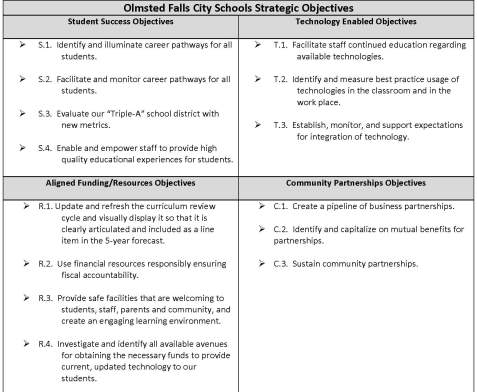 Three years ago the school district went through several strategic planning sessions that engaged multiple stakeholders–teachers, students, administrators, Board of Education members, parents and other members of the community. As the writing team began to formulate the ideas, those not participating in the actual writing were asked to provide feedback as to whether or not we were on the right track. The end result was a revised Vision and Mission statement, a reaffirmed list of beliefs and a set of strategic focus areas (Student Success, Technology Enabled, Aligned Resources & Community Partnerships) that have guided our decision making. Within each focus area the team created strategic objectives to guide the work. I’d like to focus on the objectives related to being Technology Enabled.
 OFCS Superintendent's Update