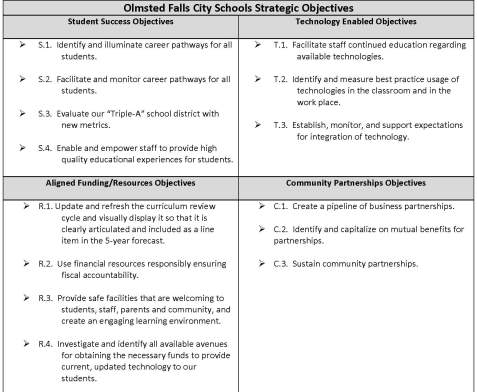
 Three years ago the school district went through several strategic planning sessions that engaged multiple stakeholders–teachers, students, administrators, Board of Education members, parents and other members of the community. As the writing team began to formulate the ideas, those not participating in the actual writing were asked to provide feedback as to whether or not we were on the right track. The end result was a revised Vision and Mission statement, a reaffirmed list of beliefs and a set of strategic focus areas (Student Success, Technology Enabled, Aligned Resources & Community Partnerships) that have guided our decision making. Within each focus area the team created strategic objectives to guide the work. I’d like to focus on the objectives related to being Technology Enabled.
The district’s three strategic planning objectives related to technology are at the top of this blog section.
- T.1. means “provide professional development to the adults in order to teach them what technology is available.”
- T.2. means “determine what the best practices are as it relates to integrating technology and gather data as to whether or not integration is happening.”
- T.3. means “create a set of expectations for integration; monitor the implementing so that the work can be supported.”
The district’s technology integration committee has been the primary driver of further defining what is meant by being “technology enabled” for the students and for the adults. It should be noted that there is no final destination of Tech Enabled-stasis. Integration is on-going, simultaneous, non-linear and organic. Here is what Tech Enabled is and what it is not.
What Tech Enabled isn’t…
- A district mentality to reach the one device per student ratio…while more technology may be nice, we’re not in a race to be the district that is 1-to-1. In other words, leading the league in the total number of devices isn’t the goal. The vision is to inspire and empower students and technology can be a vehicle in order to facilitate. The goal is a deeper level of integration. The goal is not simply, “get more.”
- More screen time for students…certainly using an electronic device requires more actual time in front of a screen, however we do not have a goal that states, “students will increase their screen time from X to Y.” Balance is key and a student isolating oneself behind a screen for extended periods of time can be counterproductive to the learning process. The goal is purposeful integration. The goal is not “more screen time.”
- Replacing teachers with technology…while technology can add value to and create a more engaged student, make no mistake about it; Olmsted Falls Teachers add the most instructional value and far more than any computer or device could. Our district prides itself on educating the whole child and while technology may augment our ability to do so, it doesn’t by itself fulfill that objective. You win with people…not machines. Sorry SkyNet.
What Tech Enabled could be…
- To me, “Tech Enabled” means integrating technology into the instructional environment (where appropriate) in order to inspire and empower students.
- That could be done by simply teaching students how to use a particular productivity tool in order to make it easier for them to generate ideas or as complex as teaching them how to use software to create something brand new. As the superintendent of schools I certainly don’t have the market cornered on good ideas and integrating technology into the classroom is no exception. As the leader of the district one of my jobs is to empower others to enact their respective skill sets.
- That being said, we have two district Technology Integration Specialists who provide professional development to our staff. While they do many things, fundamental to their role is adult empowerment. They teach the teachers how to more effectively integrate technology into the classroom.
- According to Olmsted Falls Technology Integration Specialist Dawn Carlin, “Technology integration is using technology resources in a seamless manner within a classroom setting. The goal is not simply ‘use technology,’ but to use technology resources to support the curriculum, help students reach their goals and for students to become more actively engaged in the learning process.”
- According to Olmsted Falls Technology Integration Specialist Jeff VanArnehm, “Successful technology integration is achieved when technology becomes transparent to the learning process. Students should have access to a variety of tools that match the task at hand. The emphasis is not on the technology itself, but on solving a problem or achieving a learning goal. Technology should provide students the opportunity to extend their learning or build a deeper understanding of content.”
Thanks for listening.
Jim
 OFCS Superintendent's Update