Several years ago the district pulled together a group of external and internal stakeholders to revise our Vision, Mission and strategic plan. It was during that time that we began to brand our “Triple A” moniker which demonstrated our long standing commitment to educating the whole child. While our core business is student learning and achievement, we recognized that student participation in extracurricular activities such as the Arts and Athletics are two very important components to the Olmsted Falls School District experience.
As we thought about how we would be in a better position to actively live out our District Vision of Inspiring and Empowering all students to achieve their full potential and become meaningful contributors in a global society, we recognized the primary method to communicate our district success to the community falls short using traditional methods. Ohio’s school quality reporting system uses standardized achievement tests to tell a school district’s story and we believe that by doing so, it uses a very small portion of the student experience to make a judgment on the quality of that experience; something that we believe is very inaccurate and lacking depth. While test scores will likely be with us for the foreseeable future and they do play a part in determining student achievement, we believe that we can and should provide our community with a more accurate and truthful representation as to what we’re working on and how we’re doing.
Over the past two years our District Leadership Team, which consists of administrators and teachers, has learned a new methodology to relay to our primary stakeholders what we’re working on and the progress that we’ve made. While we are the first district in Ohio to undergo this transformation, other school districts in Georgia, Texas, Kentucky and Pennsylvania have been engaging in this work.
Why use this approach?
As I previously mentioned, standardized achievement tests sample a very small portion of a student’s knowledge and do so in a single sitting. The information that is obtained is very technical. We needed to find a way to account for our efforts in a far different manner than what happens in our test-obsessed world. Moreover, when we’ve talked to parents, teachers, students, community members and businesses about the kinds of skills and dispositions they desire for students in K-12 education, their responses were very comprehensive. In Olmsted Falls we’ve led with this question–What are your hopes and dreams for your students? The responses included the following: “I need them to show up; A solid foundation in reading, math, history and science; I want my child challenged; They need to develop their thinking skills; Intellectually curious; Find their passion and purpose; Have friends, be happy and feel a sense of belonging; Learn to be communicative, collaborative, creative, and self-directed.” When you ask people what they want from their school district they speak in the language of “benefits.” You buy a car for a number of reasons, but one reason is the benefits that it will provide you. You do the same with a phone, the hospital you choose to use and so on. As we continued to explore the hopes and dreams question with stakeholders, we found the answers we were given focused on the comprehensive benefits people expect the school district to provide.
We believe that by creating a new accountability system that is grounded in the benefits that people want and the district provides, would lead to a more accurate and much more truthful accounting of what we do compared to the method that currently exists. The reporting system that we’re developing will provide progress in language that parents understand rather than “educator-speak.” We will provide a report in non-technical language to those that want the information, and for those that want to take a deeper dive into the evidence, data and how we’re gathering it, we can take them on that trip as well.
When are you starting this and what can we expect?
We plan to launch our benefits-based accountability system this fall and will provide our first progress report in November. We will provide additional updates in February and May. While we will be required to continue to live within the test-based model our state requires, our community can expect to see reporting on the benefits that each school will select from 7 main categories: Student Learning, Student Readiness; Student Engagement and Well-Roundedness, Student Well-Being, the Effectiveness of our Staff, Community Connections and an Effective System. In totality there are about 31 benefits that fall within each of the 7 categories.
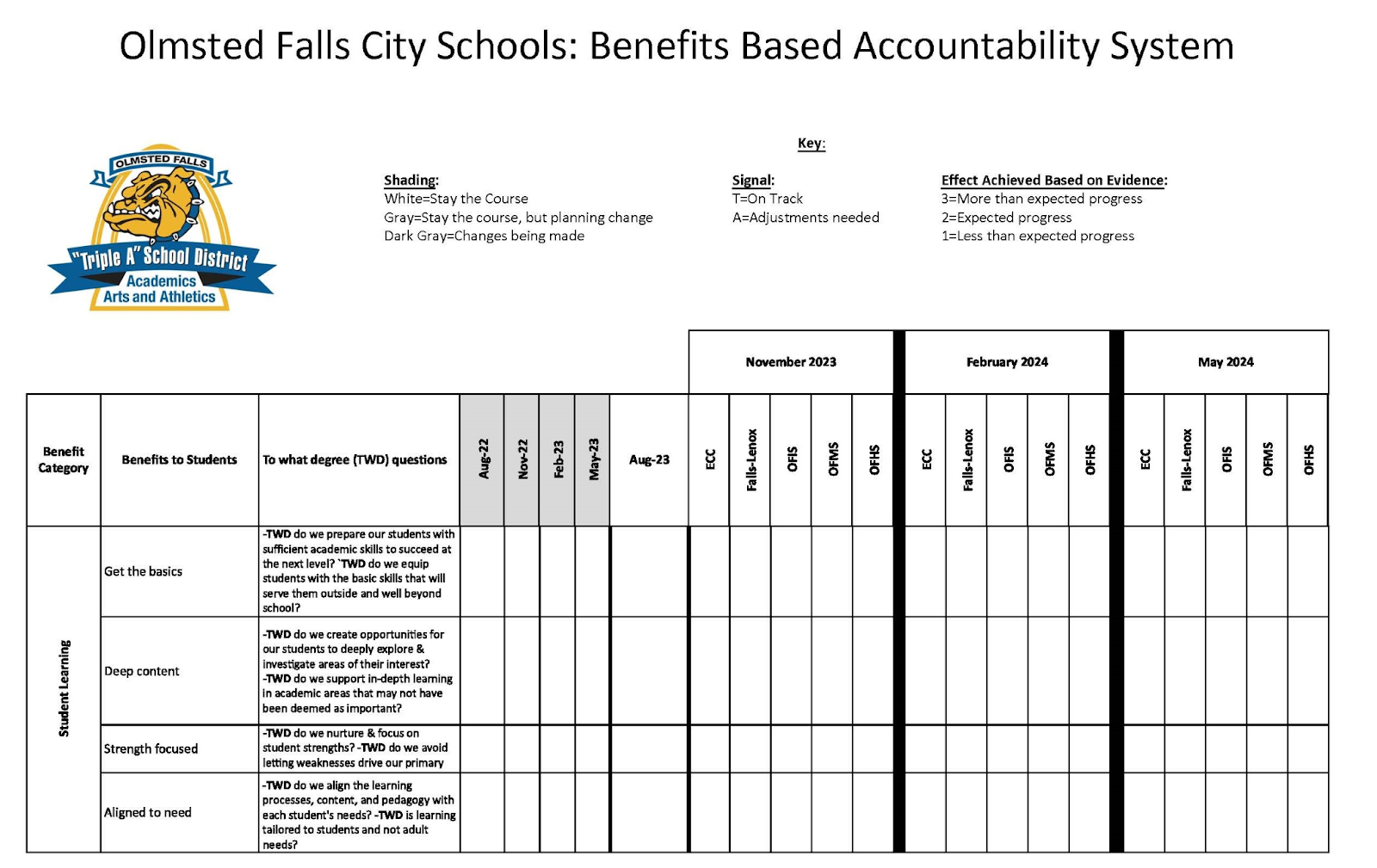
Each of our five schools have engaged their primary stakeholders to determine the benefits that will be their focus and while data will not be collected on all 31, our accountability system will report on those things that matter most as identified by our staff and primary stakeholders (parents and students). Below is an example of the format that we will use at the district level. The category in the example provided is from the Student Learning area and as you can see there are 4 main benefits within the category. Families can expect each building to provide an update on the benefits that were chosen from 7 main categories. While the 31 benefits are common across the district, the benefits chosen by each building will be unique.
We look forward to continuing to talk about this work and having conversations with our community to let them know that we are focusing on and gathering evidence on the things that they care about the most.
 OFCS Superintendent's Update