I’m Concerned and You Should Be Too If You Value Public Education

I’ve worked in the field of public education for nearly 28 years. It is a field that I’ve dedicated my professional life to, and its future is in significant jeopardy because of political polarization. I should note that before I’m a school superintendent, I am a 52 year old white dude who was raised by a single mom within a working class community on the westside of Cleveland. I come from a family of democrats who were steel workers, coal miners and car builders. I was on government assistance when I was younger. We didn’t have much money and life wasn’t easy, but we had love. I tell you these things, not to gather your sympathy, but to let you know who I am, where I come from and that I’m a public education success story. Public education helped me to become the person that I am. I am a husband, father of 3 kids who graduated from public schools, and I’m an Ohio voter that is a member of the majority party in my state. I am fortunate enough to work in a district with an incredible Board of Education that supports my outspokenness, and I do not take that for granted. Presently, I am very, very concerned for public education in our state, and it has never been more apparent in my life that statements like “country before party” or “principles before party” ring true. Public education is in serious trouble in Ohio and I would appreciate it if you read what I have to say, and consider it.

Absolute power tends to corrupt & absolute power corrupts absolutely.” -Lord Acton

I was never politically active as a young person, and do not consider myself to be politically motivated (famous last words right?). While politics have certainly been at the front and center in education and represent something I need to consider when making decisions, I’ve always believed that boards of education and those that function as school superintendents should operate with two things in mind–how do our decisions impact ALL students, and do the decisions or policies that I support help me to inspire and empower the students that are impacted by my decisions.

With gerrymandered political maps in place, the last election in Ohio has created a supermajority in our state. This means that the “ruling party” (in this case the Republicans) has the necessary votes to create veto proof legislation. Some see this as an opportunity to “finally get things done,” however as Lord Acton said– “power tends to corrupt and absolute power corrupts absolutely.”

Proposed Ohio Senate Bill 178 is a Bad Idea

We are in a lame duck session in Ohio and outgoing State elected officials are going to look to rush legislation through. Up first is Senator Bill Reineke’s Ohio Senate Bill 178 which seeks to keep in place the “form” of the Ohio School Board, the State Superintendent and the Ohio Department of Education, but completely remove their substance–the primary reasons these groups were created. SB 178 seeks to rename the Department of Education as the Dept. of Education and Workforce. The bill would create a Director of Education who would be appointed by the Governor.

Reineke’s move is the political nuclear option to change it all and determine how education would be governed and run in our state. It’s a shrewd political move because it doesn’t violate Article 6, Section 4 of the Ohio Constitution, but serves as an example of absolute power corrupting absolutely. Remember we are in a lame duck session and this individual is seeking to fast track a bill that would disintegrate the “will of the people.” When I voted for who I wanted to represent me for the Ohio School Board position, I voted under the guise that the person would be in charge of helping to determine the policies, rules, and responsibilities that would guide education in our state. In addition, when I voted for the Governor, I didn’t vote for the person to be the “educational czar of Ohio.” We the people of Ohio need to speak up and let our representatives know that they need to be more honest and patient when it comes to this level of reform. Yes reform needs to occur, however the current velocity and magnitude of SB178 is a very bad idea. Changes should be vetted rather than steamrolled through.

Prediction of What’s to come in 2023: An End Around Attempt to Ohio Constitution Article VI, Section 2

Article 6, Section 2 has been in place since 1851 and it states–“the General Assembly shall make such provisions, by taxation, or otherwise, as, with the income arising from the school trust fund; will secure a thorough and efficient system of common schools throughout the state; but no religious or other sect, or sects, shall ever have any exclusive right to, or control of, any part of the funds of this state.”

This article in our State Constitution doesn’t say “the money follows the kid” or “parents get to use public dollars to choose private religious schools.” It says create a thorough and efficient public school system and no religious or other group should have any right to the control of those funds. That seems pretty clear to me. This section of the Ohio Constitution will again be a headline that you will read about in the coming weeks and months. There’s a lawsuit that over 100 districts have filed to defend that section of the Ohio Constitution. If you’ll recall the DeRolph case in Ohio found that the Ohio General Assembly did not deliver on what the Ohio Constitution requires–the “funding a thorough and efficient system of common schools” part (4 times it was found unconstitutional). While the Governor’s budget has more money for public ed than it ever has, it still does not deliver on thorough and efficient. Moreover, the bipartisan funding formula that so many people spent time and energy on was only partially funded in the Governor’s last budget. That bipartisan formula needs funded at the level that it was designed in order to determine if it indeed meets the “thorough and efficient” test. With the political supermajority that will be in place with the next Ohio Congress, full public school funding through that bipartisan formula will be in jeopardy. Here’s why:

Matt Huffman will be President of the Ohio Senate. Senator Huffman is “the voucher guy.” Huffman believes public tax dollars that are collected in Columbus should be used to pay for your neighbor’s choice to send his or her son/daughter to a private, religious school. Derek Merrin from Monclova Township will be the new House Speaker. Derek is also a school choice guy. So the conditions of expanding the use of public funds for a private education are set because the leader in the House, and the leader in the Senate are both in favor of further expanding the school voucher program. Both get to determine what is discussed and voted on in their respective establishments. The voucher program uses public dollars to fund subsidiary educational options. Options are fine. Who doesn’t like options, just don’t take the resources that are earmarked for public schools as required by the Ohio Constitution to fund subsystems and options. If legislators want to do this, they should try to change the Ohio Constitution. Put the language on the ballot and let the people of Ohio decide if they are ok with funding secondary and tertiary systems of schooling. If they say, “yes” then I’ll sit down, be quiet and look to relocate.

I do not have a problem with religion or private schools. I studied scripture and was confirmed in my church long ago. The current system does allow parents to have choices. You can choose to send your student to a common set of public schools funded by the citizens of Ohio as the Ohio Constitution requires, or you can choose to opt out of that required system and privately send your student to participate in something else (i.e. a private school, a religious school or you can home school). What shouldn’t happen is funding other systems when the system bound by law to fund isn’t being funded at the level it is supposed to be because you don’t like that system. It would be like me saying, “I don’t like the public park system, I want the portion of my taxes that I pay for public parks to go towards my Cedar Point pass.” Or, I’m not pleased with the __________ system as defined by the Ohio Constitution so I think we should create a secondary system and pull taxpayer money to fund it. There are billions of tax dollars at stake when it comes to the education of Ohio’s children.

The obligation under the Ohio Constitution is to fund public schools, however a group of politicians have highjacked the system and they’ve created several subsidiary systems because they are convinced public education is broken (although they’re using a telescope rather than a microscope to diagnose the problem). They think that competition (competition is great…bring it on) is the way to help raise the tide so all the educational boats can rise. They will tout school choice as the saving grace to help all of the poor black, indigenous, persons of color have the ability to get out of a broken educational system. What they ignore are the facts. 1–The majority of students taking vouchers are white and many never stepped a foot into their local, public school systems and 2–socio-economic conditions that exist within many communities that do not do as well on the current state report card compared to my school district have greater challenges which impact the very metrics they use to come to the conclusion that a school is good or bad (yes…test scores…the system is rigged and the BS is institutionalized).

Should proposed Senate Bill 178 get through Ohio’s Senate and House, it will be the beginning of the end for how public education is guided in our state. This coupled with further voucher expansion that most certainly will be on the table now that a single party owns the House and Senate will be the final crushing blow.

Public education is in very big trouble and Ohio’s citizens need to help preserve it by speaking up and speaking out. We need to pay attention and get activated.
State Report Cards Deter Us From Our Vision

P.S…Stop with the damn rankings

As we moved into September we saw the Ohio Department of Education release its annual State Report Card that is its way of reporting school quality to constituent groups. As many know, I have been very critical of this system because it exclusively utilizes standardized test scores as a way to provide information to students, parents and others as to how well a school system is doing.

OFCS’s journey began 8 years ago through a strategic planning process that involved students, educators, parents and community members. We began with the recalibration of our district’s vision and landed on–We INSPIRE and EMPOWER all students to achieve their full potential and become meaningful contributors to a global society. With this vision in hand we began asking ourselves, how do we know when students are inspired and empowered? What does a school experience look like when the experiences students are provided with inspire and empower them? Olmsted Falls Schools has long provided a comprehensive Triple A experience for students through academics, arts and athletics. As we looked at the Ohio Report Card system that has remained virtually the same for over two decades, one that focuses exclusively on test scores, we saw the short-sightedness of that kind of accountability approach. Why is it short-sighted? Consider this, students spend about 420 minutes per day in school. That’s 2,100 minutes per week and about 75,000 minutes for a school year. That is a considerable amount of time. Why should a school quality rating rely on a piece of data that was gathered in 80 minutes on a particular day in the spring? Because those results help to predict the long-term outcomes for kids (they don’t)? Because that’s the way it’s always been? Because a group of people said that’s the best we could come up with? Again, this is the school accountability approach that has been in place for the past 20 years. It is an accountability system that does more harm than good. It forces teachers to teach to the test and shrink a student’s learning experience down to tested subjects. Olmsted Falls deserves better. Ohio deserves better. 

Did you know that Ohio’s $75 million accountability system uses an 80 minute sample to rate each school district on achievement, how much students have progressed from year to year (i.e. their growth), whether students are on track for literacy, and if districts are closing learning gaps for targeted groups of students?  A student’s 75,000 minutes of an annual schooling experience is contingent upon how that student performs on an 80 minute experience per subject tested (generally that’s math and reading). We believe there are better ways to account for school quality. Twenty-first century methods that pay homage to the student’s 75,000 minutes of time spent in classrooms coupled with the amount of effort teachers put forth each day with them. 

It seems that every decade a new group of stakeholders throughout the State of Ohio get together and they attempt to tinker with (also known as “reform”) the current system to make it more understandable for community stakeholders. The most recent group of reformers included local superintendents, elected officials, leaders from the various teachers’ associations, members of the department of education, outside watchdog groups like the Fordham Institute and Ohio Excel. The result–the same approach but rather than using letter grades, this time we were delivered a  system of stars. Are these types of annual assessments important? Sure, however they provide us with a small portion of evidence to account for learning and school quality. They come nowhere close to accounting for what people in positions of power want you to believe they do–regardless of whether they try to justify them with letter grades (A – F), a star system (1 – 5) or some other system of symbols.  

Over the past 12 months, we have been actively working on a better way to demonstrate school quality. Olmsted Falls Schools was the first district in Ohio to join a network of school districts throughout the country that are seeking to transform (not reform) how we account for the student experience. The approach takes into consideration the 75,000 minutes that students are in school annually and seeks to deliver a more comprehensive report to our primary stakeholders–parents and students. We frame the conversation with the internal stakeholders (educators, administrators and so on) with this question–From your perspective, what are 5 reasons we educate children? Externally we ask students, parents and community members–What are your hopes and dreams for students? When you ask these kinds of questions, our experience has been that you begin to discover the kinds of benefits that everyone wants for students. The challenge is that answers given aren’t easily measured during an 80 minute period from an instrument that has 25 multiple choice items, 2 short answers and 2 extended responses. It takes more effort and more time.    

The National network that we are part of seeks to tell the truth in a language that is more readily understood by those that we’re providing the benefit to – our students, families and community. It won’t require a Master’s Degree in Statistics nor will it include a 17-page manual to explain the process. As we build our system it will require us to more deeply engage our students and families. Through our hopes and dreams conversations we’re learning that we need to report on Student Learning, Student Readiness for the Future, Student Engagement, Student Well-Being, the Effectiveness of Adults, our Community Connections and how Effective of a System we have. You simply can’t gather the evidence needed to tell the story from a test during 80 minutes on a day in April. These things may be difficult to “measure” but it doesn’t make them immeasurable. Yes we are required to operate within the 20th Century model that has been developed, but our goal is to more truthfully and accurately account for the almost 1,000,000 minutes that our students are with us from Kindergarten through graduation. Our commitment is to put forth the time and effort to build something that is comprehensive–something that will create a greater degree of trust with our community.  

Our vision is to inspire and empower students to make a contribution to the world around them. Any time a new policy or law drops out of Columbus, Ohio or from the Feds I put my “inspire and empower lenses” on and I ask this–Will this help me inspire and empower kids? Is it neutral or will it act as a deterrent or barrier? You may not buy into the vision for OFCS, but I bet you care about kids, education and the economy. If you do, put your lenses on and ask if the policies and laws being proposed or implemented are going to make the hopes and dreams you have for kids come true or will it deter them. Think about it.

Jim Lloyd, Ed.D.

The Debate About Ohio’s Accountability Model Continues

There are 2 bills in front of Ohio’s elected officials that seek to provide partial reforms to its current accountability model. I liken it to chefs trying to create a very good soup and they’re arguing over the ingredients that make a particular soup a very good one. The problem in this particular case is that those taking part in the cooking are forgetting that at the end of the day, the soup needs to taste good in order to be great. In addition, some aren’t even qualified chefs and shouldn’t be in the kitchen in the first place, but alas. Sure, a person may begrudgingly eat the soup that’s presented, but if you want to create something memorable, sometimes you need to start over.

In this case the debate is over using a 5-tiered grading system (A – F) versus a 6 level system using stars. As it relates to systems of measurement (much like a grading system) you can expand such a system as much as you want. Do you want to use an “A-F” system or introduce pluses and minuses? Heck you could go B- or C++ or C+++, A—. but doing so does not make your system of measurement more precise or more valid. In fact, it stretches the measurement scale to the point where those you’re reporting to have no idea what you’re trying to communicate. So…both are bad because they don’t do what an accountability system should do…clearly communicate and build trust with the audience that you’re communicating to. Yes measurement should occur. We do need assessment results to help us understand where we’ve been, but imagine driving to a location and all you’re doing is looking through your rear-view mirror.

In the words of John Tanner, one of the challenges of a school reporting system is that a group of people who are inside the organization (those that have all of the technical knowledge) are trying to report on a great deal of information to those outside of the organization so that they can see the benefit of forming a relationship with that organization. In this case…the public school district with its stakeholders. The rub is, those outside of the organization have very little technical knowledge. Tanner’s True Accountability model enables “an understanding regarding the technical work within an organization for a non-technical audience.” https://www.brave-ed.com/blog When the information presented enables others to understand the benefit, trust is built. When it is unclear, trust is broken.

It is clear that in Ohio we have some significant trust issues because we continue to mess around with the same types of metrics (e.g. the same soup ingredients) rather than trying to do something brave…something just…something transformative…something great. So from my perspective, use 5 grades, 8 grades, or 10 grades. Or, introduce 5-stars, 7 stars or 9 stars. The model is still bad, the benefit of public education isn’t easily understood and the trust doesn’t increase. In fact, the system that has been in place for the past 20 years has created a sense of distrust with public schools and Ohio’s elected officials have used it as leverage to continually expand the concept of school choice. Doing the same thing over and over while expecting different results is Einstein’s definition of insanity.

I’ll end with a few citations from people who have shaped my understanding of the topic of organizational measurement.

Tanner’s most recent blog that resonated with me:
Effective organizations all over the world begin and end their accountability conversations with the notion of benefit and when schools can do the same on a regular basis the amount of information and understanding our stakeholders will have will far surpass anything that exists today. And if our stakeholders can understand what is happening in our schools, so can our policy makers. -John Tanner

Finally, to those who are part of Ohio’s accountability conversation from the Fordham Institute and Ohio Excels who claim to be representing businesses, I’ll remind you of what Jim Collins wrote–1) “Business thinking isn’t the answer and 2) Greatness is not a function of circumstance. Greatness, it turns out, is largely a matter of conscious choice and discipline, 3) It doesn’t matter whether you can quantify your results. What matters most is that you rigorously assemble evidence–quantitative or qualitative–to track your progress” -from Good to Great and the Social Sectors

People will read about Ohio’s Report Card/Accountability debate and you will hear things like, “this isn’t perfect but no reporting system is.” When you hear comments like I’d encourage you to put it into this context. Think about a major purchase that you’d make. Something that will impact your daily financial life and cause you to put a significant amount of thought and care into such a purchase. Will you say things like–
“Well this car isn’t safe, but no car is….this house isn’t well built, but no house really is.” Would you accept that? If not, why would you for your children?

Kids have but one journey through their K-12 experience. If you’re not willing to accept an answer like that for something you’re spending a great deal of money on, why are you willing to accept it from our policy makers and elected officials. Expect better. Understand the benefit of public education and demand that they do it right. Require them to “do it right or do it over!”

~Jim Lloyd, Ed.D.

Email to Ohio State Board of Education

The email below as sent to Ohio State Board of Education members and other interested parties on April 14, 2021. It is in response to a quote from a communication that originated from a document called Focus Education which is put out by the Hannah News Service, Inc. This news service provides information to subscribers about proposed Ohio Laws and policies. Those receiving this email are listed below. NOTE: I owe a debt of gratitude to John Tanner for his continual inspiration on what true accountability is. He is both wicked smart and truly inspiring to read and listen to.

Laura.Kohler@education.ohio.gov,
Charlotte.McGuire@education.ohio.gov,
Christina.Collins@education.ohio.gov,
Kirsten.Hill@education.ohio.gov,
Meryl.Johnson@education.ohio.gov,
Paulo DeMaria <paolo.demaria@education.ohio.gov>,
John Tanner <johnt@testsense.com>,
Diana.Fessler@education.ohio.gov,
Antoinette.Miranda@education.ohio.gov,
Tim.Miller@education.ohio.gov,
John.Hagan@education.ohio.gov,
Michelle.Newman@education.ohio.gov,
Brendan.Shea@education.ohio.gov,
Eric.Poklar@education.ohio.gov,
Mark.Lamoncha@education.ohio.gov,
Martha.Manchester@education.ohio.gov,
Stephen.Dackin@education.ohio.gov,
Paul.Larue@education.ohio.gov,
OFCS BOE <ofcsboe@ofcs.net>

Dear Mr. Toal,
I saw in a recent communication that comes from the ODE a quote by you that said, “you’re never going to have equity until you measure, it’s impossible.”  While I don’t completely disagree with your quote, I thought I’d offer some perspective to you from the field. I’ve been an educator for 27 years and a superintendent for 8. In a previous life I was a school psychologist and student measurement was my forte. I also wrote my dissertation on Ohio’s Value Added Assessment model. I share this with you because I have a good understanding of how to measure student learning and school quality from a traditional sense, and also from a more contemporary view. 

Both personally and as a school superintendent, I am not in favor of either bill that has been proposed to measure district or school accountability, and based on the models that are being proposed (both past and future), my district will likely benefit from the model based on the zip code of where my district is located. We are suburban and have a socio-economic situation that has traditionally benefited us with regards to school ratings. My district has the good fortune to be mostly immune from the consequences of not performing well on Ohio’s accountability model–both in the past and likely in the future. It would be in my best interest and the interest of my district to simply shut my mouth and wait for either model to move forward, however that would be wrong for me to do. 

Simply put, we will never “measure our way to equity”…not with the previous accountability models nor with the proposed ones. Measurement doesn’t improve school quality. Changing adult behavior improves school quality and we have over 2 decades of evidence to demonstrate that measurement does not improve equity of education. What has occurred during my professional career (and what is occurring now), is an exercise in “tinkering” with reform rather than a desire to be transformative. While I do believe people mean well and are trying to do the right thing, sadly I don’t think they fully understand the transformative work that needs to be done in Ohio and at the National level. Both of Ohio’s proposed models will do nothing more than put a new coat of paint on a failing and broken down car. It may look good for a few years, but it will run poorly.  You see, because of the zip code where I both reside and have the good fortune to be superintendent, I have the opportunity to work on many of the curricular initiatives that my educational colleagues do not because I don’t have to worry about accountability to the Ohio School Board or Ohio Legislature. While I would put our instructional program and how we conduct the business of school up against any of the top performing districts in the state, our focus doesn’t have to be centered on Ohio’s accountability model. In fact, my board has locally rejected the state’s model and have come out against any accountability model that relies on Ohio’s achievement tests to rate the “goodness” of what we provide to our kids. These same circumstances and conditions do not exist for my colleagues in East Cleveland, Cleveland City, Akron, Warrensville and other school districts that struggle with the reality of poverty. They do not have the good fortune of starting the accountability game with runners standing on second and third base like districts that have median family incomes of $90,000+. 

I would argue that Ohio’s current and proposed accountability models do not work for any school district–including the very wealthy school districts that do not have to worry about poverty. The students that come through the doors there come through with generally stable homes with both parents who are financially secure. Those students have benefitted from an enriched background that has a very well documented and proven direct and correlated impact on their student achievement from the very beginning of their formal schooling experience as measured through traditional standardized achievement tests and those assessments that we’re required to deliver to students in the spring.

I would argue that Ohio’s assessments do not do a reliable and valid job of measuring the impact of schooling because they’re skewed by the opportunity (or lack thereof) that home lives provide. I would argue that is the reason why Ohio’s accountability model does not work for students who come from a more privileged life AND those that do not. It is why I’ve tried to advocate for a more holistic accountability system and why I’ve spent the past few years creating one at the local level. It is why I will spend the last 9 years of my career advocating for something better.

While the State Board certainly deserves to understand how the system of public schools are performing, the models that have been used for the past 2 decades and the ones that will likely come in the future, will not provide you with any new information. You already know what the data will look like prior to implementing the proposed systems. The wealthy suburban’s will continue to do well and the poor urbans will underperform…and remember this is coming from a superintendent who works in one of the “wealthy suburban’s.”    

I’m sure that you and your colleagues care about the low performing students and want to do what you’re able to do to assist districts, however past (and likely future) accountability models in our state have done nothing more than rearrange the chairs on the deck of what appears to be a ship stuck dead at sea. I would encourage you and your fellow board members to learn more about true accountability and look to be transformative rather than tinkering with reform. Transforming the state’s accountability model will not be easy and it will be difficult, but it is very necessary if you are truly dedicated to seeking equity for Ohio’s public school students. By sticking with the past and future models you are not ensuring equity…you are sentencing districts to more of the same that will allow the suburban schools to focus on all of the good stuff and leave the urbans with test prep to improve their scores in order to get out from under the state’s proverbial thumb. 

Please consider what true accountability can offer Ohio’s students.  I’ve spent the past 4 years learning more and exploring something more progressive in order to hold myself and our school district accountable to our local community. It’s still new and only in its 2nd generation…the pandemic didn’t do us any favors. I’ve attached a few things here for you to investigate. I believe the State Board of Education in Ohio wants to make a difference in the lives of students, but I’m concerned that those pushing the buttons and pulling the levers are listening to politically charged groups who are trying to keep us in the 20th Century because they’re either afraid or they don’t know any better. Like many, I was in the accountability cave watching the shadows on the wall thinking they were something that they are not. It wasn’t until I left that cave and saw that there was a great big world of other ideas to consider that I became a real advocate for accountability.

Now is the time to be brave and to be transformative. You don’t achieve equity through measurement. You achieve it by transforming the behavior of the adults in the system…those that create the system and those that operate within it. Our kids need us to do what is right, not what is easy.  


Sources for a more holistic model of accountability:
https://www.brave-ed.com/
https://www.mciea.org/

Attachments (to the reader–>email me directly if you would like these…Google will find them for you too):

What Does a True Accountability System Look Like in Schools? by John Tanner

Building a Better Measure of School Quality by Jack Schneider, Rebecca Jacobsen, Rachel White and Hunter Hehlbach

2018-2019 OFCS Balanced Scorecard 2nd Edition

Thanks for your time and consideration.
Sincerely,
Jim

Dr. Jim Lloyd
Superintendent for the Olmsted Falls City School District
26937 Bagley Rd. Olmsted Township, OH 44138
Phone: 440-427-6000
Twitter: @OFCSSuper
Web: www.ofcs.net

Our VISION is to inspire and empower all students to achieve their full potential and become meaningful contributors in a global society. 

We Will Get to the Other Side

“I wish it need not have happened in my time,” said Frodo. “So do I,” said Gandalf, “and so do all who live to see such times. But that is not for them to decide. All we have to decide is what to do with the time that is given us.” 

-from J.R.R. Tolkien’s The Lord of the Rings

When we look over the past ten months, one quickly recognizes that our collective world has been presented with many challenges on multiple fronts (e.g. politically, socially, educationally, health & safety, etc.).  Those challenges have been unprecedented, and when people become seemingly “pressed” from multiple sides, it certainly makes sense that our core biological responses are triggered or activated. We are pushed into a state of  flight, fight or freeze. During these times it becomes difficult to get yourself “unstuck” and far too easy to remain in a frame of mind that is negative. Be good to yourself and try not to do that.

As a school superintendent, I will tell you that while the job is always challenging, my colleagues and I often talk about how we’ve entered into a new realm. There isn’t a class nor a book that can prepare oneself for leadership through a pandemic. While the school superintendency is often riddled with being second guessed, we are now often reserved to the fact that big decisions will leave 50% of our constituents pleased and 50% with displeasure and sometimes anger. 

I find it helpful; almost therapeutic– to write and reflect during difficult times. It helps me think and clarify my thoughts. Within this short piece my hope is to provide some evidence that even during one of the most troubling times in education, there is excellence and resiliency.  In addition, while learning certainly looks different at this time, everyone needs to recognize that it is happening–with or without a typical school experience. And…it happens for adults as well. It has often been said that experience is the best teacher and when you’re operating in a time that is as unique as it gets, it seems as though I’m learning new things almost every minute. 

It is somewhat difficult to find the sun through the clouds these days, but nevertheless it is important to find moments of triumph, positivity and resilience so that we can remind ourselves that excellence can, and does occur within a pandemic, and that there will indeed be a post-COVID19 future.  There will come a time when we look back and say, “look what we did…, remember how it used to be…, etc.” Recently, I solicited positive stories from parents and staff members. Listed below are some of the thankful moments from the lives of students, staff and parents. While it is paradoxical to remember that in the middle of difficulty, lies opportunity; 2020 will always serve as our generation’s case-in-point. 

Courage Merry…courage for our friends.”

-Eowyn, from Tolkien’s The Return of the King

Listed below in no particular order are moments of strength, thanks, courage and brief stories of gratitude.

“If I had one holiday wish…I would wish for there to be no more coronavirus.  Then we wouldn’t have to quarantine anymore, then we wouldn’t have to wear masks anymore, then we wouldn’t have to social distance anymore, and then we would be back to school every day and having fun together!  I believe that’ll happen one day.  I have hope.-Shared by an OFCS Teacher

One day during the Falls Lenox lunch line rush, I was serving a teacher some soup and she commented on a child’s beautiful natural red hair. The child smiled and the teacher then said her own hair is boring brown and sometimes even grey. We laughed but the child said “At least you still have hair!” and we all smiled and commented what a great outlook and positive point that was from the child. -Shared by an OFCS staff member

The OFHS Class of 2021 is rising to the challenge and adapting to the new normal. This class explored institutions of higher education through virtual tours, virtual college fairs and virtual visits (many that were held through Naviance). Most seniors had to make decisions about whether or not to submit ACT or SAT scores as part of the more widely used and sometimes confusing test-optional policies. In November, The Common Application reported there was an 8% decline nationally in applications from the previous year and 60% of the 921 colleges that are a part of the Common Application are seeing a decline in applications. I am very proud of our seniors because they are pushing forward with their post high school plans and seeing that there is indeed a light at the end of this pandemic tunnel. They are making good decisions based on their educational and career plans-Shared by an OFHS staff member

Dr. Lloyd and Ms. Williams: Mrs. Kostraba has managed to make this weird year “fun” (amazing right), has done an amazing job putting together learning menus for hybrid days and has clearly spent an incredible amount of time putting together material that makes this easier on us parents. ~Shared by a grateful parent 

The district launched a new program this year at the high school called the Fundamentals Program. The purpose of the program was to provide a supportive learning environment for students that do not thrive within a traditional school model.  From School Counselor Carlos Rivera–The program’s success can be attributed to two factors. First, the online platform (Edmentum) is flexible, and even when OFCSD went all remote, our students were extremely successful and were able to still get their needs met. Second, our 2 teachers, the administration, and I have built personal relationships with the students. Here are testimonials from students in the program:

Alan ¨Better than in-person learning.¨

Mumin – ¨Great program made me a better student¨

Sophia – ¨I truly enjoy this program, I have never been more motivated to complete my classes. The edmentum program is very easy to navigate, and it’s well organized which doesn’t make me feel overwhelmed with the work I have to do. I also really love the environment Mr. E has created for the students in his classroom. It’s a very good balance of being able to get work done while also being able to enjoy my time at school. Not to mention all the teachers involved in the fundamentals program are such kind, genuine, and supportive people who I know want the best for their students and will do anything in their power to help them reach their goals.¨

Isiah- ¨It´s great selective learning.¨

David- ¨It´s the only reason I am going to graduate.¨

Joey ¨It’s really helpful honestly I wouldn’t be where i am right now if it wasn’t for edmentum.¨

-shared by Mr. Rivera at OFHS

I have the opportunity to work with the IT department When we briefly went  remote. When I told my children what I was going to be doing they all laughed at me. No big surprise there since they are my go to when I have Tech problems. I can tell you I was nervous since it certainly has never been a strong suit of mine. Nevertheless I was up for the challenge. I was able to get myself through a power wash so that if and when it came time to help one of the students I could appear to know what I’m doing. Without any help I was able to do so and quite honestly, was quite proud of myself. Sure enough the very next day my first phone call of the morning I had to get a student through a power wash. The student and I were successful to get his computer up and running. I guess It is possible to teach an old dog new tricks. -Shared by an OFCS Staff Member who has pitched in and learned something new

Dr.  Lloyd, Thank you for never giving up. -Sent by a parent to the superintendent

The point is that our kids love school, even in 2020, and I know that at the core, that’s because you have and are an amazing staff with hearts to serve and do right whatever school needs to look like. None of these amazing teachers have ever taught nor administrators guided education in this way before, and all are above and beyond still getting to know our kids on a personal level, taking care of their specific hearts and needs, and pushing them individually to be their best in all the right ways. We are so blessed to be here in Olmsted Falls, and we are so thankful for all of you.  -From a parent with children at the ECC & Falls-Lenox

I wanted to share a brief story about something “good” that has come out of this pandemic. My daughter struggled in the spring with remote learning. It was really difficult for her to stay engaged or to muster any interest in her grades or in finishing work. None of it mattered to her. It was heartbreaking to see a really bright, creative, funny, sweet kid just retreat into herself and give up. This year, having two days a week of “in-person” school has made all of the difference. She gets up early on her in-person days and is unusually positive about going to school. She has discovered a love for painting, and her art teacher, Mrs. West, has gone out of her way to encourage my daughter. She knew that the remote days/weeks would limit the ability of my daughter to have the supplies she needed to paint, so she encouraged her to come up to the school to get some extra supplies that she could use to paint- for the love of creating the artwork. Not for an assignment or a grade…just because painting was important to my daughter and Mrs. West saw her potential. It’s made a huge difference in her emotional well-being. We are grateful.  -from a parent of a student at OFHS

Miss Simpson has lessons that are engaging, age appropriate,  lively, and she is very organized! She has so much energy in her live sessions-  that is it is contagious!  As an educator, I admire her use of technology and organization, and enthusiasm.   As a parent, I am so happy to have her as my son’s teacher.  George loves logging in for school and is very happy with his first real school experience.  His favorite part of the week is her “lunch bunches”, where the kids log in during lunch time and chat and eat their lunches together virtually.  It was such a hit, that Miss Simpson now does this twice a week.  -From a parent who has a student in a full remote learning pathway

Look for stories of hope, resilience and courage in your household and place of employment. They’re there. Hope everyone continues to hang in there despite the difficulty.

Season’s Greetings!

Sincerely,
Jim

Rebuttal to Ohio Excels Business Coalition’s Poll

As changes to Ohio’s state report card system continues to be debated, there was a report that came across the wire from a group that writes about Ohio Statehouse news with an educational focus. In order to provide Olmsted Schools constituents the information therein, I wanted to provide portions of that report along with some insights.

Parts of the report are listed below. My comments are in blue whereas their findings are in black.

Here is part of what was reported:

“Parents responding to a new poll on state report cards expressed support for the type of letter grade system used now versus alternatives like star ratings or descriptors.” Note…this is the conclusion they reach based on the information that is provided below (My comment).

“In the poll commissioned by Ohio Excels, a business coalition focused on education and workforce issues, letter grades won plurality support in comparison to other methods, and large majorities of respondents expressed that A-F grades are understandable and appropriate as a way to convey school performance.” Not really sure how they drew the conclusion of “appropriate” because it was never asked based on their report (my comment).

“The poll is based on a survey of 655 parents from Dec. 30 through Jan. 15 and has a margin of error of 4.4 percent. The parent’s survey included an oversampling of African-American and Hispanic parents. Columbus-based research firm Saperstein Associates conducted the poll.”

“Surveyed parents were asked whether the following three options are more or less appropriate as a measure of school or district performance than letter grades: one to five stars; a 0-100 numerical score; descriptive text, such as “below expectations,” “meets expectations” and “above expectations.”  Here is where the bias begins…they presented 3 options as an alternative to letter grades which assumes that letter grades are the best option to begin with…which they are not. (My comment)

“For star ratings, 20 percent said they were more appropriate than letter grades, versus 39 percent who said less appropriate and 41 percent who rated them “about the same.”

“For the numerical score, 41 percent said more appropriate, 23 percent less appropriate and 36 percent about the same.”

“They then were asked which of the four was the “best measure” of performance. Thirty-eight percent said letter grades, followed by 30 percent for a numerical score, 24 percent for descriptive text and 8 percent for star ratings.  Ninety-one percent of respondents either strongly or somewhat agreed that letter grades are “clear and easy to understand” as a measure of performance. Eighty-seven percent strongly or somewhat agreed that letter grades are “appropriate for expressing the overall performance of a school or district.” Not really sure what this paragraph and the previous one indicate other than respondents seemed split between letter grades, a numerical score and a narrative method being the “best measure” of performance, however they report that 91% of respondents say that letter grades are “clear and easy to understand.” Clear and easy because grades are generally given by teachers? Remember that a student’s grade isn’t based on a single test score. If it was, parents would revolt. Student grades are based on a collection of evidence over the course of 45 days of instruction [generally]  with multiple measures to determine A, B, C and so on. If we wouldn’t base a student’s grade on a lone test score why in God’s name would we base an entire district’s grade on a test given at a particular moment in time? Because it’s easy…because that’s how we’ve always done it!?!  (my comments)

“Ohio business leaders understand the importance of maintaining a report card system that clearly, honestly and fairly evaluates schools and school districts, while giving parents and communities insight into how well their schools are helping students learn,” said Lisa Gray, president of Ohio Excels, in a statement. “We know there are changes that need to be made to certain components to make the report cards more transparent and honest depictions of how schools and districts are performing. “Our goal is to ensure that Ohio maintains a system that helps highlight successful schools, encourages underperforming schools to continue to improve and drives increased student performance for all Ohio students. Findings from this poll should help to inform those discussions and help direct resources and supports to the students that need it most.”

Ohio Excels presented testimony in favor of keeping the letter grade system to a legislative study committee on report cards.”

Ohio Excels used their survey to create a report and drew conclusions to keep the A – F system in place. They recommended this to the Ohio Legislature. Here is the story behind the story: 

– 59 percent of respondents said they’d seen an Ohio Department of Education (ODE)-issued school building report card before, while 33 percent had seen a district report card. Only 33% of respondents had actually seen a district report card (my comment)

– 54 percent of respondents said it was very important, and 35 percent somewhat important, to have ODE report cards describe the performance of their children’s public school buildings. Numbers were similar for report cards on school district performance. Not exactly a huge endorsement for Ohio’s Report Card system.  (my comment) 

Respondents did indicate that reporting on reading proficiency was important (95% and it is) and that providing a measure related to how well students are prepared for success after high school graduation.

Here’s my problem with the study and the findings:

Asking the right question(s) is often more important than getting the answer(s). The right question isn’t whether an A – F grading system should be used, or whether or not people find it to be the “most popular” and “easiest to understand.” That’s how we should label food contents, not school districts comprised of children.  Ohio Excels data shows that most people polled: 1) have never seen an Ohio District Report Card and, 2) respondents didn’t think any of the choices were better than the other compared to letter grades. They took that data and reported: “large majorities of respondents expressed that A-F grades are understandable and appropriate as a way to convey school performance.”   First off…that’s not what the data says based on the data they revealed and secondly, this statement is wrong.

The question needs to be bigger in order to consider a different type of response. Here’s my question–“What is the right accountability for the job to report on how school districts are meeting their obligation of educating and growing kids on those things deemed to be important that allow them to be happy and leading productive lives so that they can make a contribution to the 21st Century world and beyond.”  That’s the purpose of school. Call me crazy, but it seems to me that you’d want to get up and move around the state and country to see how others are doing it rather than sitting in the room with the same people who are coming up with the same ideas.

Keep in mind the people that should be part of that conversation (what is the right accountability) extends well beyond members of the Ohio Legislature and businesses in Ohio. Such a system needs to consider all of the users–parents, community members, students, educators, and others. If you’re going to ask Ohio’s parents what they want, do it right and broaden the dang question. Ask them what their hopes and dreams are for their children and I promise you, you aren’t going to hear anything about an A-F system, a 0-100 point scale and a 5-star system. The things they will identify will extend far beyond an SAT or ACT score, or any test that gathers data at a moment in time and then tries to predict the future. 

If you’re interested in these types of questions and discussion, I’d point you to someone that I’ve learned a great deal from recently. Read more from John Tanner about True Accountability here.

Olmsted Falls City Schools: Thoughts on School Funding & School District Rankings

OF District 12.10.19The district will be on the ballot on March 17, 2020 for an operating levy that will provide resources aimed at continuing to provide a high quality Academic, Arts and Athletic experiences. We’ve spent considerable time and effort on building our Triple-A brand and that quality is in jeopardy. Our community will need to weigh in on what they’re most comfortable in supporting. I wanted to provide my take on a few things that I’ve read and heard in order to provide some insight.

On School Funding

  • School finance in Ohio is complicated. The funding system has been ruled unconstitutional 5 times and it still has not been fixed. It’s unconstitutional for a number of reasons, but the main one is that it relies too heavily on local property taxes to fund the schools when the Ohio Constitution says it is the state’s job to provide a thorough and efficient education. This is a fundamental problem and it has not been fixed. I would encourage you to ask your locally elected Ohio Legislator what they are doing to fix Ohio’s school funding system.
  • Only the Ohio Legislature can fix Ohio’s school funding problems that rely heavily on property taxes. For a district like ours that has very little industry and commercial property, the tax base remains the responsibility of the residents that choose to move here and remain here.
  • Data from our 2017 and 2019 voter surveys indicated that the majority of people move to the Olmsted Community for the quality of the schools.
  • As you know we are on the ballot in March for an operating levy. The unfairness or “unconstitutionalness” of Ohio’s over-reliant on property taxes is on display. Did you know that 1 voted mill for an operating levy for Olmsted Falls City Schools generates about $520,000 and 1 voted mill for an operating levy for a district further north of us (a district where I worked for 9 years) generates $1.4 million per mill? It means that we’re required to tax ourselves 3 times as much to generate the same amount of money for the schools. Seems unconstitutional doesn’t it? Nevertheless it is our reality and until the model is fixed, this is where we are.
  • Our residents have told us that they are very tax sensitive. As a result, the district has a history of waiting until it is absolutely necessary to place a levy on the ballot and then we stretch it for as long as we can. It has been stretched for 10-years. Ten! When the dust settles, we will need to engage our community and ask them if we need to go on more frequent for less or less frequent for more, but the fact remains the Olmsted local economy is based on the support of residents rather than business. While the businesses that are here do indeed pay, the Olmsted residents have a heavier burden. I pray and hope that will change. It’s why we need to bring businesses in rather than build more homes.
  • Some would argue that the only way it can be fixed is to simply vote “no” on every school levy, however there are consequences to the students at the local level. Simply put, we cannot provide what we cannot afford. It costs money to educate students. We’re a service organization and people provide the service…people cost money.
On School Rankings
  • Like you, I live here and pay taxes. I live in Woodgate and with the increased value in my home, I will take a large hit. I’m fortunate that I have a good job and my wife works. I obviously believe in public education and moved my family here from one further north that has been deemed “very successful” based on traditional ratings…a place where we built our home and stayed for 10 years prior to relocating. We chose to move here. When I bought a similar priced home, my taxes increased.
  • I’m an educator and I pulled my students out of one of those “Top 50” rated districts and moved here because I believe in what we’re doing and how we’re doing it. I wanted my children to experience the Bulldog Way.
  •  Our district has chosen to be different on purpose. There was a time when I was the Assistant Superintendent in Olmsted Falls (2007-2012) and we were chasing test scores. As a data person we would analyze test results, create similar test questions like those on the exams and we would spend considerable instructional time drilling. In a district where I previously worked for 9 years, we did the same thing. We were all about the tests and our scores were very high. That may have changed since I’ve moved on, but that’s what we did.  In O.F., we were very good at the test score game and received awards for those accomplishments for 15 years. We could continue to receive those same awards if we stayed on that path.
  • When I became superintendent for the district, through professional reading, experience and reflection,  I had a professional epiphany and a change in heart that resulted in a profound shift in my educational philosophy…life is about learning and growing.  I remember thinking back to a question that one of our high school teachers posed to me about being “all in” on standardized test performances. He said, “Jim…what do we win by being in first” and “what if being at the top of the list doesn’t improve the long-term outcomes for kids?”
  • The answers to the questions were, “you win nothing” and “there is no evidence to suggest that being in first place in the standardized test score race leads to improved outcomes for kids.” Zero…nadda…nothing…no evidence. He was right, I was wrong and I needed to think, lead and behave differently.
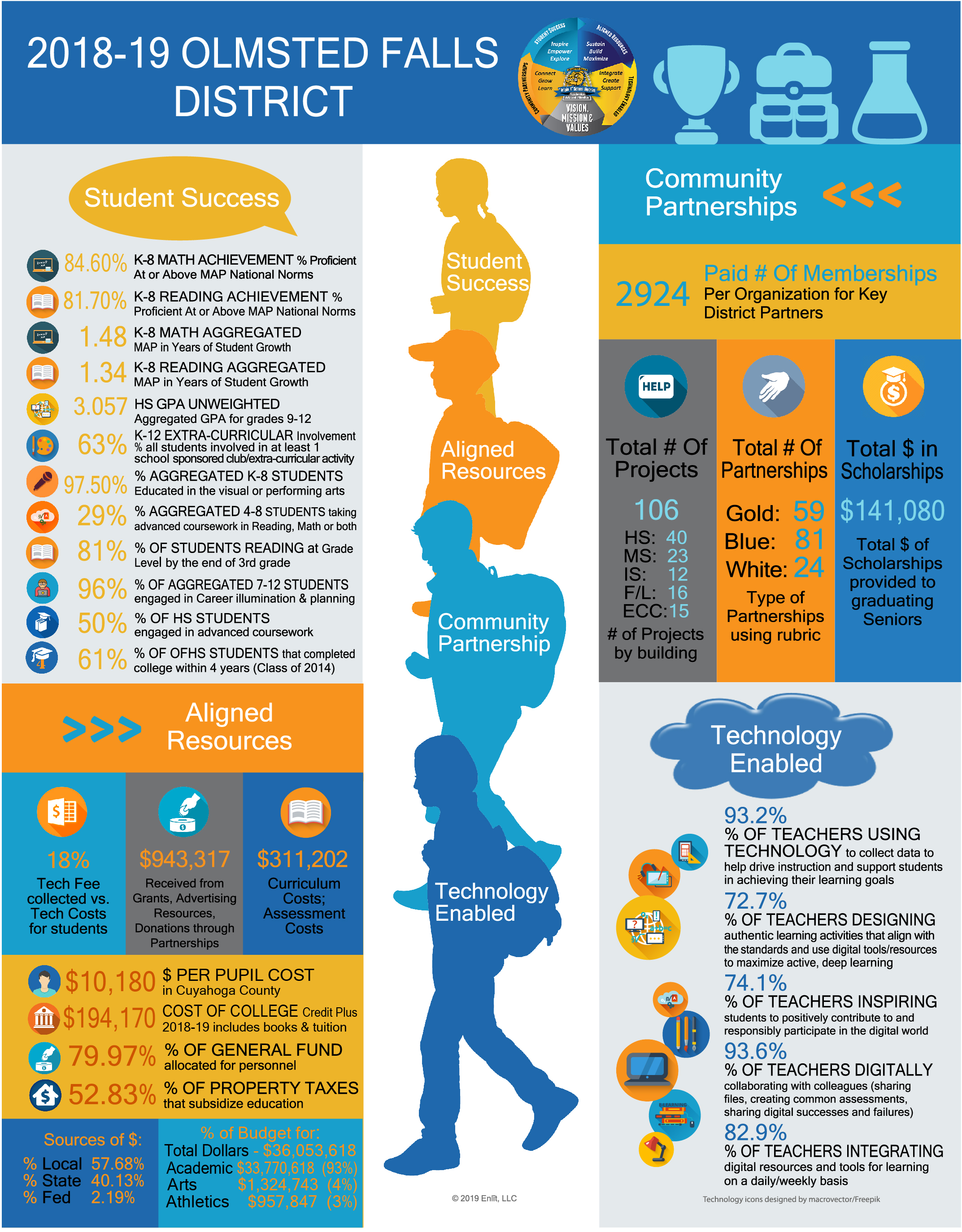
  • We have won awards from the State and from US News and World Report based on how our students perform on standardized tests, but we do not report on them because it detracts the focus from our brand and vision of Inspiring and Empowering students.
  • With support and guidance of the Olmsted Falls Board of Education we sought a new path and chose to be different on purpose. While other school districts will report their “All A’s” report cards and drill & kill, Olmsted Falls Schools will not do this…not for as long as I’m standing, breathing and working in this space. It means nothing.
  • Over the past several years our instructional focus has not been on being at the top of a list like it has been in the past. It has been on holistic education and providing a Triple A (Academics, Arts and Athletic) experience for our kids so that they can develop as people who are more able to make a profound contribution to society. That may be dreaming, but that’s what we’re doing.
  • Our focus hasn’t been on scoring first, it has been on providing engaging experiences within the classroom, on the stage and on the court & fields. Our goal hasn’t been test scores, but experiences that will empower and inspire our students to be safe, responsible, respective and kind Citizens; to Collaborate and Communicate at higher levels, to be more Creative and think more critically; and to be Self-Directed and Self-Confident.
  • Our state rating system doesn’t “count” for these things, but man these things sure count when they go to college or to work.  The people that have them deeply developed in their bones help to make the world a better place to live. I have 3 kids and 2 of them have graduated from OFHS and my 3rd is a junior. They were more than prepared when they went to college. Other districts will claim–“we do those things too.” My response is “ok, but we do them better, we do them intentionally  and they are at the core of what we believe.” It is the Olmsted Falls City School District’s vision for the future and for our students.
  • We’re working on ways to measure and report on the skills and dispositions that we’ve deemed important. While they may not show up in a list of rankings, they will prepare the students that experience them for more than a standardized test. We’re not in the test score business, we’re in the mind, body and soul development business–and when we partner with our families and community at a profound level we do us, we do it differently and we do it well.
I would ask the reader to share this with others so that they understand the value that the school district provides to the community’s children. I’ve been in a few different places and have had experiences in some very successful school districts based on those traditional measures. I’m a professor at Baldwin Wallace and have taught aspiring principals and superintendents  and I will tell you–Olmsted Falls is different, and it is different on purpose. It is special and very unique. At the end of the day each person who votes will need to vote based on their financial situation, but they shouldn’t think for a minute that we are somehow “less” or “unworthy of support” because we’re not listed in the top 50 of Ohio’s School District rankings based on test scores. We quit that test score chasing game a long time ago.
We’re playing a different game on a different field. Our scoreboard just happens to look different.
Thanks for listening.
Jim

High School Graduation Requirements…Understanding the Problem Before Designing the Solution

Ohio has released an updated set of graduation requirements for public school students to obtain a diploma. Recently a reporter (@paodonne) asked for my take on the situation and I was going to call him back. I should say that I appreciate the Olmsted Falls Board of Education, the administrators and all of my colleagues in the system because without you, I’m nothing. You put the wind in my sails. Together we achieve greatness.  Here it goes…

Albert Einstein said that, understanding the problem is often times more important than the solutions that are generated. More specifically–“If I had an hour to solve a problem I’d spend 55 minutes thinking about the problem and five minutes thinking about solutions.” That says a great deal to me. Einstein had one of the best minds in the history of the world and the guy essentially says– I need to think about what I’m trying to solve (inside and out) before I can offer a solution. Profound right? Let’s think about this as it relates to Ohio’s high school graduation requirements. Let’s think about the problem and encourage others to do the same.

Here are some questions: 1) what was the purpose of public education at its onset…the genesis of it? 2) what problem was it trying to solve? Likely answer–The purpose was to try and determine who would contribute, and how would they contribute to the continuation of the American way of life? Worthy goals.

That question was addressed by a committee of 10 people who designed the public educational system…a really long time ago. From 1890 through 1980ish, the solution that was developed worked. Essentially, “let’s sort the people that are worthy of running businesses from those that “work” and contribute to the development of an industrialized country.”

My grandfather who served in the Pacific Theater in World War 2 and had a sixth grade education benefited. Prior to being an Army Sargent he worked as a coal miner. After WW2 he moved to Lorain, took a job with the Ford Motor Company and raised a family. The economy at the time had plenty of manufacturing jobs for people, and while my grandfather did not have a formal education, he was, by all indicators, successful. He worked, contributed to society and raised a family. The “good ‘ole days” didn’t have a large number of people graduating with high school diplomas because…check this…it didn’t have to! The system, as designed, did its job. It sorted people and my grandfather was sorted into a manufacturing job. The same sorting mechanism occurred for his 3 sons. All graduated high school in the 1960’s and contributed in the same way. The public educational system worked as designed.

Fast-forward to 2019 and think about the same question that was posed above: 1) what is the purpose of public education; and 2) what problem are we trying to solve now? The answer to this question is profoundly different when compared to the question that was asked long ago, and herein the challenge is revealed. Are we faced with an entirely different problem, or are we simply trying to evolve the purpose of the system that worked for my grandfather post WW2? I’d argue that it is different…profoundly different! The problem of how to “leave no child behind” or “providing a high quality education for all” is a significantly different type of problem compared to the problem that existed when the system was created at its onset (see Tony Wagner’s work).

In order for current K-12 students to be ready to excel (let alone survive) in the kind of world that exists in 2019, is vastly different when compared to post WW2; yet the system of public education has remained largely intact. Sure we have STEAM, STEM, AP, and honors courses. However, our system is set up to go this way–Algebra, Geometry, Algebra 2; Physical Science, Biology, Chemistry; etc. In Ohio, we’ve also introduced the idea of holding students and school districts accountable to “higher standards” by requiring a set of assessments throughout their public educational journey. We’ve instituted a ranking and ordering system—a sorting system if you will; in order to help the public determine who is good at this game, and who isn’t.

My response to, “what do you think about Ohio’s new graduation requirements” is this–those pulling the strings still don’t fully understand the problem and, as Einstein tells us, it is more important to understand the problem than it is to define the solution.  The problem we face in Ohio (and even the Nation) is–

How do we provide learning experiences for students that will engage them and enable them to make a difference, contribute in the 21st Century and beyond AND, moreover;  how should public school districts provide evidence that they are ensuring this mission has been first launched and, second, progress is being made?

This is a local, state and federal question. The current method of accounting does this poorly on all levels. First, how is this done with local communities, and second, with the state that supports these efforts, and finally, with the Federal government that has an interest that this is occurring despite providing very little resources to make it happen? Our Republic and way of life is important. Despite our flaws, I love this country.  NOTE–the order of questioning outlined above is purposeful and important. The job of educating citizens is left to each state before it is addressed by the Nation.  As a school superintendent I feel my local obligation before my obligation to the state or feds. At least in Ohio, I’m held accountable to my local community…or at least I should be because they provide the lion’s share of resources before the state does.

I would argue that if you don’t understand the problem fully and you’re trying to develop a solution, you’re not going to fully solve the problem. How could you? The high school graduation solutions generated feel like a series of “tweaks” or adjustments to me because those making them don’t fully understand the problem. I’ve been in the K-12 Public Education arena since 1994, and it feels like tweaking to me. I’ve been “tweaked” more  at the federal and at the state level than I have locally; and I think that’s wrong. Here’s a walk down memory lane for evidence:

  1. Kids benefit more from peer interaction than they do teachers so let’s bus them to different places (Coleman Report). FAIL
  2. Public education is wallowing in a “tide of mediocrity”(A Nation At Risk). WRONG and FAIL.
  3. Let’s create a set of incentives to create educational standards by state to ensure they’re focusing (Goals 2000). GOOD idea that got twisted so FAIL.
  4. We’re leaving kids behind, we need to hold them accountable, let’s test them on a single day to see how they rate and rank. Let’s mandate “local” report cards that are heavy on testing indicators (re-authorization of ESSA through NCLB). FAIL because it wasn’t forward thinking.
  5. Achievement scores aren’t the right idea because the poor kids struggle, so let’s think about this new idea of “value-added” and determine how much growth kids are making compared to others (Still NCLB). GOOD idea, but Ohio FAILED because of the model it chose. 
  6. Let’s take that idea of “value added” and use it to rank kids and evaluate teachers, principals and districts. NOTE–this was not the initial purpose of value added. TRIPLE FAIL. Ohio’s model has inherent socio-economic variables that made the model fallible as evidenced by the fact that we’re moving away from it for the purposes of evaluating principals and teachers.
  7. In Ohio and other parts of the Nation, let’s create a set of National learning objectives and then rank and rate students on the accomplishment of those…let’s race to the top and hold a carrot in front of states and provide an unprecedented amount of resources to compel them to that end  (Race to the Top). SUCCESS conceptually (common standards), but FAIL because of the assessment system focused on a very small set of learning objectives. FAIL x 50 for each state.
  8. Holy cow, we’re still leaving kids behind, let’s put even more tests in front of them to see how they rate and rank (the re-re-authorization of ESSA). FAIL.
  9. In Ohio, “let’s reduce testing because the constituents are complaining about it.” NOTE: not, “let’s reduce testing of subjects on a single day at a particular point in time because it is only a sample of accounting for learning and this is an inaccurate way to determine what kids know,” but “let’s quiet them down.” FAIL because the problem isn’t clearly understood. You can assign more FAIL if you’d like. 

FAIL, FAIL, FAIL, FAIL and more FAIL. My colleagues and I have been 20th Century model “tweaked” to death, despite having a 21st Century “calling” and duty to prepare students for jobs and careers that do not exist.  As a school superintendent I am asking students and teachers to live in 2 worlds. Prepare them for the 21st Century (we’re currently in this remember) and help students pass the tests (a 20th century technology). That’s a problem. In my opinion, I believe that the majority of those in the field would agree with me, however they don’t say it for a variety of reasons. Local school boards have been hypnotized to believe that the system is just and they perform well within it. Why would you advocate for a different model when you’re at the top of the heap in the current one? Some are part of districts that do not perform well within the system and to speak out against it would be construed as sour grapes and shedding their accountability requirement. Other districts are currently “occupied” (see Lorain, Youngstown and East Cleveland) and it would be “educational heresy;” and there are those that may simply disagree with my logic (likely a small few). I would encourage my fellow high performing districts to show no deference to Ohio’s accountability system–the “All A” seals, the growth awards and the banners–not because you don’t deserve the accolades for the hard work you’ve done, but because this model does not seek to improve the outcomes or report on the most important 21st Century outcomes for ALL kids in Ohio. The graduation requirements and the accountability system is unjust and inaccurate from the inside out. It offers nothing.

I’ll offer these 20th Century fun facts–

  • Being named a Valedictorian or Salutatorian has no bearing on a person’s ability to make a contribution in the 21st Century. Some students and parents may like it, but it doesn’t matter. Thankfully in my district we got rid of that long ago. To the Ohio House Rep that is considering putting this into law…consider reading. Truth be told, I graduated high school with a 2.7 GPA and obtained one of those diplomas that, “didn’t mean anything,” because I didn’t pass a battery of tests to bless it as meaningful. I’m a first generation college student related to a grandfather that fought in the Pacific Theater in WW2 with a 6th grade education, and worked on the line for the Ford Motor Company. ‘Aint’ that America!
  • Passing an Ohio End of Course exam shows no evidence of improving the outcomes of students longitudinally. You may be eligible for an Ohio Diploma, but it doesn’t mean you’ll be successful just because you successfully passed a battery of tests. Even if you win, you still may lose.
  • High scores on the ACT, SAT or any other assessment show no evidence of a person’s ability to make a contribution in the 21st Century. It may gain you admittance, but it shows no evidence of increasing the likelihood of obtaining a college degree nor  make a contribution to society.
  • Despite the fact that we may be “losing” the achievement race in regards to the TIMMS or PISA, Americans have more patents and innovative ideas than any other country. In short, you don’t win a banner for placing at the top of the international list, or even in the top 5 for worldwide test scores. In short, “yay…we’re first…what do we win?” While data demonstrates that people with a high school diploma earn more than those that do not; there’s no evidence that test scores link the same way. Obtaining a high school diploma demonstrates considerable benefit compared to those that do not obtain one. People with a diploma live longer, have a happier life, pay taxes and are less incarcerated. People that don’t have a high school diploma experience the opposite. Remember, prospective citizens come to our country because of freedom and justice; not because we score higher than Taiwan, but because what our country has to offer them.

Understanding the problem is often more important than the solution…My response is–understand the problem fully before applying the solution(s). Ohio elected officials.

We’re not trying to improve on the American Public Educational model. The American Public Educational System is trying to accomplish something different…something awesome…something other Nations won’t assume the burden for. Educating ALL students to be prepared to make a difference and a contribution in the 21st Century isn’t a “tweak” or a reform; it’s a damn TRANSFORMATION. We aren’t faced with doing something a little different; we’ve faced with doing something that we’ve never done before…perhaps something no community, state or nation has attempted. Our transformation requires us to check the egos at the door and not rely on Fordham or any of think-tank that protests to want to put us first. It requires us to fully embrace the Portrait of a Graduate skills that many public school districts are identifying Nationally–we need to collaborate, communicate, think critically, be creative, and demonstrate steadfast citizenship. It is the “road less traveled.” It isn’t easy, and there isn’t a script or research study that has been written. America has never been about easy or quick. We’re slow; bogged down and dang right calculated. It’s always been about a debate and a conversation and this conversation needs to be inclusive (all constituents), and it takes time to do it right.

I firmly believe that our elected officials get into the business of service to do the very best they can. I’ve had great conversations with my representatives in Ohio and I know that they care and want to do well. No one in their right mind would put themselves into the fray otherwise. In the interest of simply “getting it done,” they sometimes get lost. Ohio’s current graduation “tweak” is…meh. It makes some adjustments, but it still doesn’t understand the problem. High standards…yes! Content competency? Yes; however content isn’t enough. Honestly, what matters most in the 21st Century isn’t content competency…it’s important, but not enough. Those that want standardized tests want evidence of competency; however what matters most is very difficult to measure–but not impossible. We need to recognize that a student’s performance on a test that measures a sampling of the learning objectives at a particular point in time is not sufficient to say that they’re competent or incompetent. It is a very, very small sample of learning at a particular point in time. It’s easy, but it won’t work for our transformation. Relying on assessments doesn’t make an Ohio diploma mean something. Just because someone tells you that standardized tests makes a diploma mean something doesn’t make it so. It may be what all the other states use, but it’s insufficient.

My concern with Ohio’s Graduation Requirements is that it continues to rely on a sample of a student’s test performance on a particular day at a particular time. It is a partial accounting (thanks John Tanner) of skill and it puts socio-economically disadvantaged students at risk for failure when they may not be failing. It ignores poverty and the challenges that many Ohioans face. Kids don’t shed their problems or their poverty at the school house door before they enter our buildings. If you can highly correlate test performance with income; that says something. It says the deck is stacked against some and favors others. Just because you start the game with a runner on third base doesn’t mean that you hit a triple. The current system is morally wrong…even though my school district performs very well within the current system. We can debate all of the psychometric properties of these assessments and end at a stalemate, but the graduation solution and accountability system, at its core, is just plain wrong.

We need to clearly understanding the problem before we apply the solution. My take is that the vast majority still do not fully understand the problem.

My grandfather said, “do it right, or do it over.” He wasn’t educated, but he was smart.

Thanks for hanging in.

Jim


Note: I owe a considerable debt of gratitude to the following people for the ideas that they’ve put forth that have helped to enlighten me. I didn’t site your works specifically, but by God you’ve inspired me in more ways than you can imagine. To the reader…Google them and read all that you can. Thank you.

Tony Wagner

John Tanner

Ted Dintersmith

Phil Schlechty


What’s the Purpose of a Portrait of an Olmsted Falls Graduate?

Operating within a test-based accountability universe is very challenging because it runs counter to our District Vision. We’ve chosen to reject this model and follow another pathway for our students. Why…because to follow it would blur our vision and take us off course. 

Our district’s vision is to Inspire and Empower our students. We do that through our focus on Academics, the Arts and Athletics. These three areas provide the school district’s forum to further develop our students to be successful adults. Having a forum is only one variable to inspire and empower. From an academic standpoint, we need engagement; and in order to more formidably engage our students we will continue to design or redesign higher quality learning experiences to enable this to happen. In some instances we will need to create new opportunities from scratch, and in other cases it will only take slight adjustments to the instructional program.

As we are designing and redesigning instructional experiences for students, the standards and course content serves as the foundation, however we know it isn’t enough. In Olmsted Falls Schools we believe that there are 7 student competencies that are so important to a student’s development, we felt the need to identify them, and begin to clearly ensure they are a major part of the student experience. These 7 competencies are so big and so critical, they permeate not only a student’s academic experience, but the experiences they have in their extra-curricular programs. Sometimes a student’s extra-curricular experience is in the Arts, or through Athletics…but not always. Other students are involved in clubs and groups. Regardless, all of these opportunities are in existence, not simply because they are “nice to do,” but because they serve as a unifying force to our student purpose ethos. They provide growth opportunities in Citizenship, develop a student’s Self-Confidence, help kids become more Self-Directed, assist in the refinement of Collaboration and Communication; and possibly become more Creative or more adept at Thinking Critically. It is the responsibility of the adults in charge (all of us) to ensure, make visible and amplify the connection of these important competencies to everyone–most importantly to the students that we serve.  


Inspire and Empower them.

How?

Purposefully design the work so that it engages them.

Why?

Because at the end of the day, the skills and competencies that will matter most to students…those things that they will rely on when they’re out in the world, aren’t found within the items on an Ohio Graduation Test…they’re found within the quality interactions of the adults they see everyday and through the relationships they’ve forged with those in their lives.

Don’t settle. “See the invisible so you can accomplish the impossible.”  Dare to be different…the world needs more different. #EducationalFreedomFighters


Greetings! Happy Summer.

It’s nearly officially Summer and while the students are at recess, there’s so much happening. The physical structure of our high school continues to progress as does the district’s core business of INSPIRING and EMPOWERING students. That’s not just words on a page, but truly something at the forefront of our minds.

At the start of the 2018-19 school year, after what will seem like an endless summer, Olmsted Falls High School will be transformed; as will the experiences of our students. While the high school is certainly undergoing a physical metamorphosis that has our community excited, how we operate as an organization will begin to alter as well–from a K-12 perspective.

The district recently completed our Portrait of an Olmsted Graduate work, but the most important work and questions remain:

  • What does inspire and empower look like when it is done at a high level in ALL grades?
  • How might the alterations to the physical plant begin to build upon the high quality experiences that have brought countless families to the Olmsted Communities?
  • When considering the skills and dispositions contained within the Portrait of the Olmsted Graduate, what begins to change within the instructional environment?

Locally we are focused, strategic and driven.

The skills that have been identified by our community of stakeholders are not only for our high school students. These skills will serve as a K-12 rally point for our work. We will continue to build upon our excellence–K-12, we will ask ourselves what are the contributions of the ECC, Falls-Lenox, OFIS, OFMS and OFHS staff, students, parents and community along our road to excellence. We will do this, yet the system doesn’t require us to; nor does it even support our efforts.

As a public school district in the State of Ohio we are faced with this–we have an antiquated school accountability model that is embedded, ingrained, tied, tattooed, legislated and inextricably woven into the very fabric of Ohio’s Code (both Revised & Administrative) that governs our day-to-day business; yet our public and business community  (and I’d argue the general public/business community well beyond our district) does not want what’s been offered. Our results at the local level articulate this as does the public opinion from PDK’s most recent poll on public schools. It will take a collective community effort to lead the change…all of us…parents, students, educators, citizens…all of us. It needs to be a collective, “our kids deserve better!”

Rather than answering questions such as,

  • What are the aspirations and dreams that our community has for our youth;

  • Do we have a statewide, unified vision for creating a 21st century educational system for our youth?” (questions beyond local level discourse);

–both posed by Karen Garza at a recent presentation at a Battelle for Kids, Success for All Conference (those below are mine)

  • How do we assist our students with the mental health issues that they endure from the crazy system of schooling that we’ve imposed on them; and

  • Make you own list with the space that’s provided…___________________________________________________________________________________________________________________________________________________________________

…Ohio is fiddling around with answering small-big problems such as–test-based graduation requirements; should there be a summative State Report Card Grade; ODE’s Strategic Plan and so on. Rather than focusing on THE problem, the focus of our State remains on the symptoms.

On a day like today, I’m inspired and frustrated at the same time and that is how public education works much of the time.

-see you on Sunday (Browns fans will understand)